~ Dismantling the propaganda matrix. ~ Empowering a community of social,
economic and political justice. ~


Google
 
RSS - Circle of 13

Wednesday, November 21, 2007

'Bob Marley: More than a poster and a spliff'

"...In 1978 The Wailers returned to headline the One Love Peace Concert, intended to raise money for the most suffering ghettoes. During a transcendent performance of "Jamming," Marley called the country's two rival political leaders onstage, clasped their hands together, lifted them over his head and proclaimed "Love, prosperity be with us all. Jah Rastafari. Selassie I." With the power of his music and devotion, he united a nation.

On May 11, 1981, he died. Since then his visage has donned countless tapestries and hemp necklaces. That mega-selling compilation, Legend? Released three years after his death. The worst part is the hardest to understand: Douchebags and Time magazine continue to herald his worst music, the former by blasting his later, more smoothly produced fare and the latter for naming Exodus the album of the century. Bizarre doesn't begin to explain that decision; at best, Exodus is Marley's ninth best album.

The result: Some people, such as hipsters, tend to dismiss Marley entirely on the basis that his fans suck. I'm partially guilty - it took me an abnormally long time to come around. Unfortunately, not everyone does, and a lot of the above-mentioned hipsters turn into tastemakers, and thus false impressions become real.

Furthermore, a lot of his ethnicity has been stripped from him. Reggae is still generally filed under the vague "world music" label, a category that Marley himself is largely responsible for creating. Worse, the urgency has also been stripped from his music. The image of Bob Marley in our world now is one of ganja and peace, love and acoustic guitar jams with your best bros. Where is the blood and suffering? The cries for burnin' and lootin' or revolution for all men?

Because Robert Nesta Marley is no longer with us, his name and image are entrusted to us to protect and his message to spread. So put down the bong, put on Catch A Fire and figure out how you're going to make a difference in the world..."

~ read in full... ~


Ronald Jenkees

My Response to a Muslim Call for Common Ground (by Jim Wallis)

Christianity and Islam comprise the world's largest communities of faith - 2.1 billion Christians and 1.5 billion Muslims. If these two religious traditions cannot find ways to keep peace between themselves, the world will be in very serious trouble. As Brian McLaren posted earlier on this blog, a group of 138 Muslim scholars and clerics recently sent an open letter to Christians around the world, A Common Word Between Us and You. In it, they proposed that

Muslims and Christians together make up well over half of the world's population. Without peace and justice between these two religious communities, there can be no meaningful peace in the world. The future of the world depends on peace between Muslims and Christians.

The basis for this peace and understanding already exists. It is part of the very foundational principles of both faiths: love of the One God, and love of the neighbour. These principles are found over and over again in the sacred texts of Islam and Christianity. The Unity of God, the necessity of love for Him, and the necessity of love of the neighbour is thus the common ground between Islam and Christianity.

A group of scholars at Yale Divinity School's Center for Faith and Culture wrote a response, Loving God and Neighbor Together. To date, the response has been endorsed by almost 300 Christian theologians and leaders, and it appeared on Sunday as a full page ad in The New York Times. The response begins by acknowledging that

… we were deeply encouraged and challenged by the recent historic open letter. … We receive the open letter as a Muslim hand of conviviality and cooperation extended to Christians world-wide. In this response we extend our own Christian hand in return, so that together with all other human beings we may live in peace and justice as we seek to love God and our neighbors.

After affirming the Muslim letter's emphasis on love of God and love of neighbor as central to both faiths, the Christian response concludes

"Let this common ground" – the dual common ground of love of God and of neighbor – "be the basis of all future interfaith dialogue between us," your courageous letter urges. Indeed, in the generosity with which the letter is written you embody what you call for. We most heartily agree. Abandoning all "hatred and strife," we must engage in interfaith dialogue as those who seek each other's good, for the one God unceasingly seeks our good. Indeed, together with you we believe that we need to move beyond "a polite ecumenical dialogue between selected religious leaders" and work diligently together to reshape relations between our communities and our nations so that they genuinely reflect our common love for God and for one another. Given the deep fissures in the relations between Christians and Muslims today, the task before us is daunting. And the stakes are great. The future of the world depends on our ability as Christians and Muslims to live together in peace.

Religious communities should not resolve their differences by killing each other. We must prevent the "clash of civilizations" that some predict or even desire. Irresponsible calls to war against "Islamo-facism," even by some Christian leaders must be countered with the spirit of the above declarations. That's why I signed this response to our Muslim counterparts and would encourage each of you to find ways to enter in to this dialogue. It's time to stop shouting and start talking. Out of that might come something even better than mere peace and dialogue - like actual interfaith collaboration in resolving some of the planet's most dangerous threats and challenges. Isn't that a better role for religion?

~ link ~


'I'll have the Bilderberger, well done!'

By Jerry Mazza
Online Journal Associate Editor
9 Nov 2007
 

" ... Somehow for 15 years Estulin managed to find the location of yearly Bilderberg meetings as they were announced, always just a week before they happened, always in some small town outside a major city, cloak and daggered with armed and vicious security guards. The meetings, first held in the Bilderberg Hotel in the small Dutch town of Oosterbeek in 1954, during the presidency of Dwight Eisenhower, did not allow press coverage of any kind. Today that remains true, even though major news and media figures may attend, that is, to plan to alter public opinion on some issue.

In fact, here is Estulin’s latest report on Bilderberg 2007: Welcome to the Lunatic Fringe. Read it, please. It includes a list of this year’s objectives and a complete list of attendees. Estulin’s razor-sharp observations will boggle your mind.

Bilderberg privacy reigns, too, to make attendees feel “free enough” to utter their innermost thoughts (a truly scary thought). Uninvited, Estulin arrives days in advance of meetings, bonds with hotel staff, even security once he gives them the past history of this group. And then there are those who know the history and come to him, eager to reveal the ugly “innermost thoughts” of someone who’d like to see a government toppled, a revolution financed, a leader disappeared (as in Aldo Moro of Italy), a president made or toppled (as in the case of Richard Nixon when he bucked Bilderbergers on his price control plan that was working). In short, the agenda is to weaken all world leadership but they’re own. Bilderberger needs, mandates, and laws, in their eyes, precede even those of the US government.

Yet planning and attending these meetings is in essence a crime. Estulin points out, “A US law, called the Logan Act, states explicitly that it is against the law for federal officials to attend secret meetings with private citizens to develop public policies. Although Bilderberg 2005 was missing one of its luminaries, US State Department official John Bolton who was testifying before the Senate Foreign Relations Committee, the American government was well represented in Rottach-Egern by Alan Hubbard, assistant to the president for economic policy and director of the National Economic Council; William Luti, deputy under secretary of defense; James Wolfensohn, outgoing president of the World Bank and Paul Wolfowitz, deputy secretary of state, an ideologue of the Iraq war and incoming president of the World Bank. By attending Bilderberg 2005 meeting, these people are breaking federal laws of the United States.” ... "


~ link ~
 

Elite troops and their 'expanded role' on intelligence

March 8, 2006
Elite Troops Get Expanded Role on Intelligence
By THOM SHANKER and SCOTT SHANE
WASHINGTON, March 7 — The military is placing small teams of Special Operations troops in a growing number of American embassies to gather intelligence on terrorists in unstable parts of the world and to prepare for potential missions to disrupt, capture or kill them.

Senior Pentagon officials and military officers say the effort is part of Defense Secretary Donald H. Rumsfeld's two-year drive to give the military a more active intelligence role in the campaign against terrorism. But it has drawn opposition from traditional intelligence agencies like the C.I.A., where some officials have viewed it as a provocative expansion into what has been their turf.

Officials said small groups of Special Operations personnel, sometimes just one or two at a time, have been sent to more than a dozen embassies in Africa, Southeast Asia and South America. These are regions where terrorists are thought to be operating, planning attacks, raising money or seeking safe haven.

Their assignment is to gather information to assist in planning counterterrorism missions, and to help local militaries conduct counterterrorism missions of their own, officials said.

The new mission could become a major responsibility for the military's fast-growing Special Operations Command, which was authorized by President Bush in March 2004 to take the lead in military operations against terrorists. Its new task could give the command considerable clout in organizing the nation's overall intelligence efforts.

The Special Operations command reports to Mr. Rumsfeld, and falls outside the orbit controlled by John D. Negroponte, the newly established director of national intelligence, who oversees all the nation's intelligence agencies. An episode that took place early in the effort underscored the danger and sensitivity of the work, even for soldiers trained for secret combat missions.

In Paraguay a year and a half ago, members of one of the first of these "Military Liaison Elements" to be deployed were pulled out of the country after killing a robber armed with a pistol and a club who attacked them as they stepped out of a taxi, officials said. Though the shooting had nothing to do with their mission, the episode embarrassed senior embassy officials, who had not been told the team was operating in the country.

One official who was briefed on the events, but was not authorized to discuss them, said the soldiers were not operating out of the embassy, but out of a hotel.

Now, officials at the Special Operations Command say, no teams may arrive without the approval of the local ambassador, and the soldiers are based in embassies and are trained to avoid high-profile missteps.

Under guidelines established by Mr. Negroponte, the C.I.A. station chief assigned to most American embassies coordinates American intelligence in those countries.

Most embassies also include defense attachés, military personnel who work with foreign armed forces and report to the Pentagon's Defense Intelligence Agency. But the new special operations personnel have a more direct military role: to satisfy the military's new counterterrorism responsibilities, officials said.

Special Operations forces include the Army Green Berets and Rangers, the Navy Seals, the Marines and special Air Force crews that carry out the most specialized or secret military missions. Their skills range from quick strikes to long-range reconnaissance in hostile territory, military training and medical care.

The creation of the Military Liaison Elements, and the broader tug-of-war over the Special Operations Command's new role, appear to have exacerbated the disorganization, even distrust, that critics in Congress and the academic world have said permeates the government's counterterrorism efforts.

Officials involved in the debate say the situation may require President Bush and his senior national security and defense advisers to step in as referees, setting boundaries and clarifying the orders of the military and other intelligence agencies.

Many current and former C.I.A. officials view the plans by the Special Operations Command, or Socom, as overreaching.

"The Department of Defense is very eager to step up its involvement in counterterrorism activities, and it has set its sights on traditional C.I.A. operational responsibilities and authorities," said John O. Brennan, a 25-year C.I.A. officer who headed the National Counterterrorism Center before retiring last year. "Quite unfortunately, the C.I.A.'s important lead role in many of these areas is being steadily eroded, and the current militarization of many of the nation's intelligence functions and responsibilities will be viewed as a major mistake in the very near future."

Mr. Brennan, now president of the Analysis Corporation, an intelligence contractor in Virginia, said that if Socom operations were closely coordinated with host countries and American ambassadors, "U.S. interests could be very well served."

But, he added, "if the planned Socom presence in U.S. embassies abroad is an effort to pave the way for unilateral U.S. military operations or to enable defense elements to engage in covert action activities separate from the C.I.A., U.S. problems abroad will be certain to increase significantly."

Paul Gimigliano, a spokesman for the C.I.A., gave a measured response to the program, but emphasized the importance of the agency's station chief in each country.

"There is plenty of work to go around," he said, adding: "One key to success is that intelligence activities in a given country be coordinated, a process in which the chief of station plays a crucial role."

A State Department official said late Tuesday, "We don't have any issue with D.O.D. concerning this," using the initials for Department of Defense. The State Department official said the Military Liaison Element program was set up so that "authority is preserved" for the ambassador or the head of the embassy.

The Special Operations Command has not publicly disclosed the Military Liaison Element mission, and answered questions about the effort only after it was described by officials in other parts of the government who oppose the program.

"M.L.E.'s play a key role in enhancing military, interagency and host nation coordination and planning," said Kenneth S. McGraw, a spokesman for the Special Operations Command, based in Tampa, Fla. The special operations personnel work "with the U.S. ambassador and country team's knowledge to plan and coordinate activities," he added.

Officials involved with the program said its focus is on intelligence and planning and not on conducting combat missions. One official outside the military, who has been briefed on the work but is not authorized to discuss it publicly, said more than 20 teams have been deployed, and that plans call for the effort to be significantly expanded.

In a major shift of the military's center of gravity, the Unified Command Plan signed by President Bush in 2004 says the Special Operations Command now "leads, plans, synchronizes, and as directed, executes global operations against terrorist networks," in addition to its more traditional assignment to train, organize and equip Special Operations forces for missions under regional commanders.

Recently, Gen. Bryan D. Brown, the Socom commander, and his staff have produced a counterterrorism strategy that runs more than 600 pages. It is expected to be presented to Mr. Rumsfeld in the next few weeks for final approval.

According to civilian and military officials who have read or were briefed on the document, it sets forth specific targets, missions and deadlines for action, both immediate and long-term.

One goal of the document is to set the conditions for activity wherever the military may wish to act in the future, to make areas inhospitable to terrorists and to gather the kind of information that the Special Operations Command may need to operate.

The problem is difficult in nations where the American military is not based in large numbers, and in particular where the United States is not at war. Thus, the Military Liaison Elements may not be required in notable hot spots, like parts of the Middle East, where the American military is already deployed in large numbers.

During recent travels abroad, General Brown has sought to explain the program to C.I.A. and F.B.I. officials based at embassies. Joining him for those talks is a political adviser on full-time assignment from the State Department.

Socom also held a conference in Tampa last summer to brief Special Operations commanders from other nations, followed by a session in October for Washington-based personnel from foreign embassies on a range of counterterrorism issues.

One former Special Operations team member said the trick to making the program work is to navigate the bureaucratic rivalries within embassies — and back at the command's headquarters. "All you have to do is make the ambassador, the station chief and Socom all think you are working just for them," he said on condition of anonymity, because he was not authorized to discuss the matter publicly.

Lee H. Hamilton, who served as vice chairman of the national commission on the Sept. 11, 2001, terrorist attacks, said that conflict between the C.I.A. and the Defense Department over paramilitary operations has occurred periodically for decades, and that the 9/11 commission had recommended that the Defense Department be given the lead responsibility for such activity.

But he said the embassy program raised a different issue. "If you have two or three D.O.D. guys wandering around a country, it could certainly cause some problems," Mr. Hamilton said. "It raises the question of just who is in charge of intelligence collection."

The cold war presented the military with targets that were easy to find but hard to kill, like a Soviet armored division. The counterterrorism mission presents targets that are hard to find but relatively easy to kill, like a Qaeda leader.

General Brown and the Special Operations Command now work according to a concept that has become the newest Pentagon catchphrase: "find, fix, finish and follow-up" — shorthand for locating terrorist leaders, tracking them precisely, capturing or killing them, and then using the information gathered to plan another operation.

"The military is great at fixing enemies, and finishing them off, and exploiting any base of operations that we take," said one Special Operations commander on condition of anonymity, because he was not authorized to discuss the matter publicly. "But the 'find' part remains a primitive art. Socom can't kill or capture the bad guys unless the intel people can find them, and this is just not happening."

Lowell Bergman contributed reporting for this article.

Copyright 2006The New York Times Company
 
~ source ~
 

Tuesday, November 20, 2007

"the most important first amendment-free speech-case in the past 50 years"

US author mounts 'libel tourism' challenge


David Pallister
Thursday November 15, 2007
Guardian Unlimited

A ferocious attack on the "chilling effect" of the English law of libel and its use by wealthy "foreign tourists" will be mounted in a top US court today, with backing from organisations that represent a majority of the world's media.

The case is being brought in the New York state court of appeals by an American academic, Rachel Ehrenfeld, against one of the richest men in the world, the Saudi investment banker Khalid bin Mahfouz. Her lawyers describe it as the most important first amendment - free speech - case in the past 50 years.

Ehrenfeld's 2003 book, Funding Evil: How Terrorism Is Financed - and How to Stop it, alleged that Mahfouz and his two sons financed al-Qaida through the family's ownership of the National Commercial Bank of Saudi Arabia and through connections with Islamic charities. In 2004, Mahfouz won a default defamation judgment against her in the high court by the leading libel judge, Mr Justice Eady. He awarded damages and costs against her estimated at £110,000.

Since the September 11 2001 attacks, Mahfouz, with a fortune estimated by Forbes at $3bn (£1.45bn), has successfully used or threatened to use the English courts on 29 occasions against similar allegations. He insists that he abhors terrorism and has never knowingly provided money to al-Qaida.

Today's hearing in the state capital, Albany, is initially about whether the New York courts have jurisdiction over Mahfouz. Ehrenfeld wants declarations that under US law Mahfouz could not prevail in a claim of libel against her and that Eady's judgment is unenforceable there.

The possibility he might seek enforcement - a sword of Damocles, according to her lawyers - has stimulated a formidable array of journalistic support. In a consolidated amici curiae (friend of the court) brief - backed by every major newspaper group in the UK, including the Guardian - the court will be urged to recognise the "growing and dangerous threat of 'libel tourism' - the cynical and aggressive use of claimant-friendly libel laws in foreign jurisdictions..." which "has chilled and will continue to chill Dr Ehrenfeld's exercise of her free speech".

She claims that "Mahfouz's systematic course of aggressive litigation is really a form of intellectual terrorism, an extreme type of literary censorship". US publishers, she says, are wary of using her work.

Although the book sold only 23 copies in the UK at the time of the original trial in 2004, Mahfouz denies he is a libel tourist.

His lawyers say he has a substantial reputation in England, and that Ehrenfeld's claims about the impact of the English judgment are alarmist and untrue.

"To the contrary, she has used this case and her legal conflict with Mr bin Mahfouz to promote a new edition of her book as 'the book the Saudis don't want you to read', to present herself as a victim of repressive English law, and to further publicise her false claim that Mr bin Mahfouz is a supporter of terrorism," the lawyers said.

~ Link ~


Mysterious Jet Crash Is Rare Portal Into the "Dark Alliances" of the Drug War

Paper Trail for Cocaine-Filled Plane that Crashed in Yucatán Suggests Link to U.S. Law Enforcement Corruption in Colombia

By Bill Conroy
Special to The Narco News Bulletin

17 Nov 2007

The Gulfstream II aircraft that crashed on the Yucatan Peninsula outside of Cancun in late September while laden with some four tons of cocaine has been the subject of considerable media and blogger attention in recent weeks.

Some reports have alleged the errant plane was previously used between 2003 and 2005 by the CIA for several flights to the infamous U.S. “terrorist” prison camp in Guantamano Bay. The fact that the ownership of the aircraft apparently switched hands twice within weeks of the crash, helping to obscure its ownership, has only further fueled media and Internet speculation that the jet’s illegal payload was being transported as part of some larger U.S. government black operation.

All that might be true — or not.

But Narco News has uncovered at least one fact that is certain to deepen the mystery surrounding the crash of the jet whose tail number, N987SA, is now affixed in the lexicon of CIA folklore. That fact revolves around the name Greg Smith, who was identified in a McClatchy Washington Bureau report on the Gulfstream II’s crash as follows:

A bill of sale obtained by McClatchy Newspapers indicates that Florida pilot Clyde O’Connor bought the plane on Sept. 16 — eight days before it went down in the Yucatan jungle. Another Florida pilot, identified by his license number and signature as Greg Smith, also signed the document, but his relationship to O’Connor isn’t detailed.

But before we introduce you to the mysterious Mr. Smith, it is important in all of this to remember that a proposition is not automatically a corollary of a seemingly related fact.

Too many conspiracy theories rest on a proof built on the six-degrees-of-separation premise — that any person on the Earth can be connected to anyone else through a chain of no more than five people. That might be true, and can make for an interesting trail to follow, but it doesn’t prove the first person in the chain even knew the last person — let alone that all six individuals acted in a conspiracy.

As the late, great authentic journalism heavyweight Gary Webb, who did meticulously investigate and link CIA activities to illicit drug running, once said:

“I don’t believe in conspiracy theories. I believe in conspiracies.”

With that understanding in mind, it is important to review the timeline of the Gulfstream II’s demise in the Yucatan peninsula— as reported by other media.

The plane took off from Ft. Lauderdale Executive Airport headed for Toluca, outside Mexico City, on Sept. 18. It crashed near Cancun, Mexico, on Sept. 24 after departing from Rio Negro, Colombia.

Mexican publication Por Esto!, whose work on the story has been exhaustive, with some 30 stories to date, and based on solid journalism, reported that the jet was headed to an airport in Cancun, but arrived shortly after a work-shift change at the airport. The security people on the new work shift did not authorize the Gulfstream II to land, so it flew to an airport in the Yucatán capital of Merida, which also would not authorize a landing.

The jet remained stranded in the air until it ran out of fuel and was forced to make an emergency landing in the hills by the nearby town of Tixkokob, Por Esto! reported.

Mexican authorities apprehended one of the pilots onboard the Gulfstream II a couple days later, about three miles from the crash site. Four days later, they apprehended a man alleged to be the copilot, though Por Esto! has questioned why none of the helicopters or other high-tech search equipment available were mobilized to find the two more quickly. Por Esto! also claimed that the amount of cocaine at the crash site appeared to be much more than the 3.7 metric tons authorities reported.

Also of importance to this story is the ownership trail of the jet itself. McClatchy reported that a Florida-based company called Donna Blue Aircraft, which is supposedly owned by two Brazilian men, acquired the Gulfstream II from a company connected to New York real estate developer William Achenbaum.

That deal was allegedly cut on August 30. Donna Blue then flipped the jet to a new owner, for a supposed payment of about $2 million, on September16.

That’s where the enigmatic Greg Smith comes into the picture, as one of the supposed co-signers on the bill of sale drafted by Donna Blue for the Gulfstream II. Media reports to date have followed the trail of his supposed partner in the deal, Clyde O’Connor, and even delved into the background of Achenbaum, but the trail on Smith seems to be cold.

Where could he be — and who is he anyway? Smith is not exactly a unique name, even in the insular world of the private-jet industry.

Well, it turns out that Narco News has run across the trail of at least one Greg Smith who has plenty of experience flying between southern Florida and Latin America — for the U.S. government.

The Vega Connection

Baruch Vega is a colorful Colombian who has worked as an asset for the FBI, DEA and CIA, among other agencies, over the years.

Vega was very involved with a series of U.S. law enforcement operations carried out by the DEA and FBI between 1997 and 2000. Those operations, Vega claims, involved brokering deals with Colombian narco-traffickers by offering them the bait of U.S.-government sanctioned plea deals in return for their surrender or cooperation.

The following is from a lawsuit filed recently in federal court by Vega, in which he alleges the government failed to pay him for his high-risk services, to the tune of some $28.5 million:

Once Mr. Vega introduced … American lawyers to the Colombian targets [the narco-traffickers], the lawyers would then get retained and then take over as legal representatives for the Colombian targets and further deal with a group of United States law enforcement agents and prosecutors, hand-picked to work out deals for the Colombian targets. A particular United States Attorney for the Southern District of Florida became the coordinator of this “recruiting effort.”

So Vega is in a position to know the lay of the land in the Colombian narco-trafficking scene — which is the source of the four tons of cocaine found on the crashed Gulfstream II jet. After all, coca plants don’t grow well in Mexico.

According to Vega, between late 1997 and 2000, he traveled between South Florida and South America via a private jet for a total of some 25 to 30 “recruiting” trips— some with FBI agents on board, some with DEA agents on board, and some transporting Colombian narco-traffickers who were being brought back to the United States to negotiate deals.

Vega claims that the main pilot for all of those flights was none other than an individual named Greg Smith.

Here’s how Vega described the situation to Narco News in a recent interview.

Well originally… I met Greg Smith… we needed a pilot, a very trustful pilot, someone we could trust to bring in the [Colombian] drug traffickers to surrender. Then the members of the FBI recommended to get in contact with this guy [Smith] because he was very close to them. Ever since we flew only with him.

Everything was with him. … I never asked anything [about Smith’s background]. But he [Smith] brought a couple of pilots because we always have two pilots in the plane. He occasionally brought pilots from the US Customs.

I tell you one thing. We flew with Greg Smith easily 25 to 30 times. All [the] operations [were] between the end of 1997 to 2000.

When Vega was asked if federal agents were on board the jet during those trips, he responded:

“Oh yes, many times. If you read the flying manifest, there were… DEA agents in the plane and of course drug traffickers who were coming to surrender with attorneys.”

Vega adds that the FBI and DEA were each running their own separate operations at the time, so the FBI also was involved in some of the confidential source recruiting trips to South America as well, and he says the Bureau “even paid for the [leased] plane a few times.”

A judge’s ruling in another legal case that is related to Vega’s pending lawsuit, in fact, backs up his claims. It describes the CIA’s involvement in one flight in 1999 that departed from Panama for Florida that involved Vega, federal agents and an indicted, fugitive Colombian narco-trafficker:

Indeed, the appellant [a DEA supervisor] used the CIA to bring Mr. Cristancho to the chartered aircraft surreptitiously, without going through Panamanian airport security or customs. The appellant simply made no attempt to conceal the use of the chartered aircraft. And, an Assistant U.S. Attorney and various DEA agents from Group 9 were at the Fort Lauderdale airport to greet the plane.

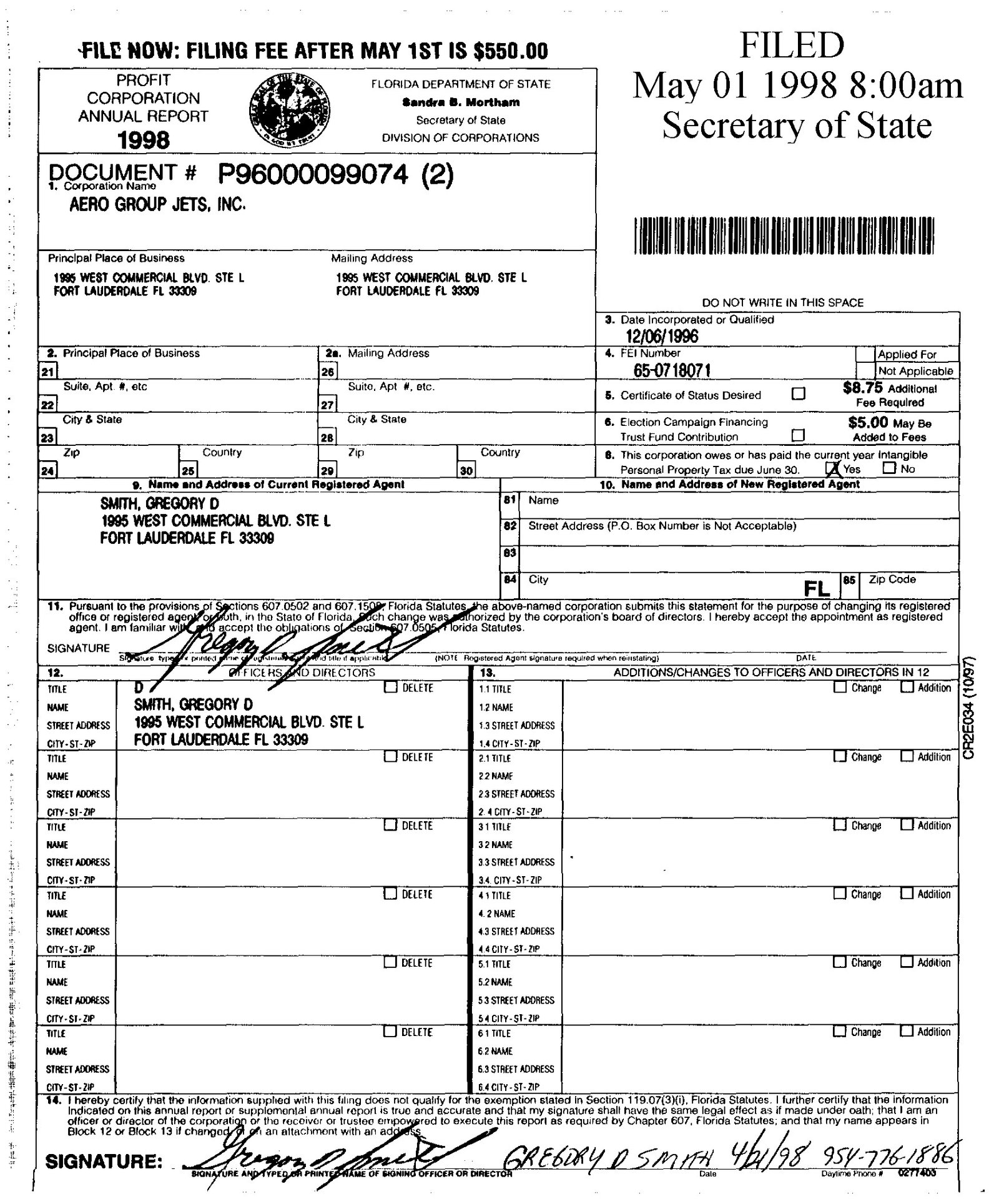
And those same legal pleadings mention the name of the company from which Vega chartered the aircraft: Aero Group Jets.

On or about November 17, 1999, the appellant [a DEA supervisor] received an invoice from Aero Group Jets in the amount of $23,200 for the rental of the aircraft used to transport Mr. Cristancho.

Vega also confirmed that Smith’s company was called Aero Group Jets.

A check of the public records available through Florida’s Department of State lists the registered agent/officer of that now inactive company as Gregory D. Smith.

So it would seem that the real question now is whether the Greg Smith who allegedly signed the paperwork in the purchase of the crashed Gulfstream II jet, as reported by McClatchy, is the same Greg Smith who was recommended by the FBI, according to Vega, to pilot more than two dozen flights to Latin America between 1997 and 2000 as part of U.S.-sanctioned law enforcement operations.

One reporter known for his spook-related journalism claims to have already interviewed the right Mr. Smith, but, by his own admission, it was through a third party — which leaves open the possibility of all sorts of shenanigans, particularly if we are dealing with real CIA spooks.

Another reporter with a Florida weekly also claims to have interviewed the real Mr. Smith. However, as it turns out, when Narco News contacted that individual, he stressed that the reporter had gotten the wrong man.

“I was falsely written up … and they named my company,” says Greg Smith, who is with a company called Global Jet Solutions of Pembroke Pines, Fla. “There’s probably three or four Greg Smiths in aviation in South Florida. But it’s not my name on the bill of sale [for the Gulfstream II jet that crashed in Mexico on September 24].”

This Smith, who says his middle initial is “J,” adds that he has hired an attorney to explore legal action against the publication that he alleges wrongly identified him and his company.

Narco News did obtain a copy of a 2007 document that contains the signature belonging to the Greg Smith of Global Jet Solutions. That signature does appear to be different than the signature of the Greg Smith contained on an annual report filed with the state of Florida in 1998 by Aero Group Jets — the firm Vega claims he leased a jet from during his many trips to South America between 1997 and 2000.

So it appears, at least for now, a cloud of mystery still conceals the whereabouts of the right Greg Smith — whom McClatchy reporters contend was a co-signer on the bill of sale for the ill-fated Gulfstream II Jet.

Many possibilities

Now, before anyone jumps to conclusions, it is important to point out that every crashed plane has its own unique story — as does every drug deal gone bad. And most don’t all involve grand CIA conspiracies directly linked to the White House — though as Gary Webbs’ investigative reporting on the CIA/Contra/Crack connection showed, those “Dark Alliances” do surface from time to time.

But for the sake of argument, let’s explore some more mundane theories.

For example, the Gulfstream II jet’s crash landing in the Yucatan might simply be a drug-smuggling run gone bad, with no mystery beyond that reality.

Or it is possible that the jet that crashed outside of Cancun was under surveillance as part of a government operation known as a controlled delivery — in which government agents allow a load of drugs to make its way to the destination (under close scrutiny) with the goal of arresting those who take delivery of the narcotics in the United States. If that’s the case, the fact that the jet crashed after getting waived off of two airports tells us only that something went wrong, that the operation was not “greased” properly, in law enforcement lingo.

As for Vega, and several former federal law enforcement sources interviewed by Narco News, both the notion that the Gulfstream II was part of a U.S. government-sanctioned controlled delivery operation, or that it was part of some kind of CIA black op, are both viewed as being on the low side of probability.

However, at least one law enforcement source with experience working in Latin America did say: “I wouldn’t put anything past those guys [the CIA]. … They aren’t even supposed to be there [in Latin America] officially, so if anything did show up [related to their operations] they would deny it.”

Vega weighed in on the questions as follows:

… I believe more it could be a run [by narco-traffickers] because a controlled delivery is very easy. A controlled delivery would make the plane land … remember how close the Keys are to the Yucatan Peninsula or any airport in Miami. And if it’s a controlled delivery by your government, that plane could land anywhere basically. Or at least land in one place until they call the agents and come and clear the whole thing. That’s why I could say more it looks like a run for one of the traffickers.

… Again, that’s what I say [in terms of the allegation that it was a CIA black operation], that’s what doesn’t make sense because let’s assume the Agency is running that thing, they could land in Guantanamo, they could land anywhere in the Keys or in Florida and wait an hour or two until someone calls from somewhere, and then don’t worry. That’s it.

But there also are other possible explanations as to the Gulfstream’s possible connections to U.S. intelligence or law enforcement that fall more squarely into the chaos of human vice —such as greed and official corruption.

With that in mind, it might be worth reviewing some past cases where human virtue seems to have gotten twisted up a bit in pursuit of the drug war.

Money for nothing

At the top of the list is the case of the Bogota Connection, which was exposed by a Justice Department memo drafted in 2004.

Vega was very involved with some of the U.S. law enforcement operations referenced in the memo. Those particular operations played out between 1997 and 2000 and sought to snare narco-traffickers with Colombia’s infamous North Valley Cartel. Remember, Vega claims an individual named Greg Smith, during that same time period, was retained as a pilot to fly numerous missions — for both the DEA and FBI — that were, in essence, confidential-source recruiting trips.

In the course of that work, Vega alleges, corrupt U.S. agents in Colombia seriously compromised his role as a government asset and that a number of his informants within Colombia’s narco-trafficking underworld were assassinated as a result.

Justice Department attorney Thomas M. Kent wrote the memo in late 2004 in an effort to draw attention to alleged serious corruption within the U.S. Embassy in Colombia. In the memo, Kent alleges that DEA agents in Bogotá are on drug traffickers’ payrolls, complicit in the murders of informants who knew too much, and, most startlingly, directly involved in helping Colombia’s infamous rightwing paramilitary death squads to launder drug money.

The first of the major allegations in Kent’s memo centers on a DEA undercover operation launched in Colombia in 1997 called Cali-Man, which made use of Vega as an asset. The operation was overseen by David Tinsley, a DEA group supervisor in Miami.

As part of Cali-Man, Tinsley and the agents working under him uncovered evidence that DEA agents in Bogotá appeared to be assisting narco-traffickers in Colombia. In one case, Tinsley’s group, as part of a sting, obtained a classified document from the U.S. Embassy in Bogota via a narco-trafficker turned informant.

After Narco News exposed the Kent memo in a story published on Jan. 9, 2006, DEA reacted by describing the corruption allegations in that memo as “extremely serious.”

However, some nine days later, after Semana, a popular weekly magazine in Colombia, published a story about the Kent memo, DEA issued another public statement describing the corruption allegations as “unfounded.”

The U.S. mainstream media has been silent about the Kent memo, and the Bogotá Connection, since that time.

It is not to be ignored, in the case of the Gulfstream II jet crash in Mexico, that the flight allegedly left from Rio Negro, Colombia, just outside Medellín, where it managed to avoid that nation’s customs and law enforcement scrutiny while loaded up with at least 132 bags of cocaine that tipped the scales at four tons.

In any event, Vega says his work in Colombia for the DEA and FBI did produce results — despite the alleged treachery on the part of U.S. agents in Bogotá and elsewhere

“All in all, Mr. Vega convinced and successfully recruited about 114 Colombian targets to enter this plan/program, about 25 of which were fugitives at the time of negotiating the deals,” his lawsuit alleges. But, in the end, the U.S. government, he contends, failed to compensate him for his work and risks as promised.

(For more on Vega’s lawsuit, go to this link.)

But the allegations of U.S. law enforcement corruption that have surfaced in the Bogota Connection are not new in the history of the drug war, for those who care to follow that trail.

For example, in the early 1990s, according to court pleadings in a criminal case filed in New York, DEA agents transported a large quantity of heroin from Pakistan to New York City, via commercial airlines, allegedly for the purpose of setting up undercover stings.

However, the defendant in the litigation, Gaetano DiGirolamo, who is now serving a life prison sentence, claims he is not guilty of the charges brought against him in 1991; in fact, he claims that DEA agents framed him, seeking to use his case as a cover for their own illegal drug-smuggling activities.

Among the claims raised in a post-conviction petition filed by DiGirolamo was that he was convicted “based upon perjury of three DEA agents.”

“(The DEA agents) testified that they were involved in importing drugs for use in ‘stings’ against me and others when in truth and in fact they were doing so for their own personal, criminal enrichment,” DiGirolamo states the post-conviction petition.

The petition goes on to raise major doubts about the veracity of the DEA agents’ purported sting against DiGirolamo — such as the fact that the alleged heroin brought in from Pakistan was never tested to assure it was the same heroin used in the sting, nor was the heroin ever produced at trial.

In addition, despite claims by the DEA agents involved in transporting the heroin that their operation had been sanctioned by DEA headquarters in Washington, D.C., as well as the French and Pakistani governments, DiGirolamo’s attorney, law professor Steven B. Duke, says those approvals were never produced.

“Where are they?” Duke asks in a court filing. “Where are the applications for such approvals? Where is the evidence that any of these approvals were sought, much less obtained?”

The DEA agents, of course, contend Duke’s allegations are baseless.

Still, it is clear that federal agents did transport 20 kilos of heroin from Pakistan to New York via commercial airlines — a fact to keep in mind the next time you are flying the friendly skies.

The U.S. Customs Service sent Duke a letter on May 2, 2000, in reply to his queries about the incident. The response was prepared by Bonnie Tischler, then assistant commissioner for Customs’ Office of Investigations. (Customs is now part of the Department of Homeland Security.)

From Tischler’s letter to Duke:

Dear Mr. Duke,

Thank you for your March 3, 2000, letter regarding the importation of narcotics into the United States by law enforcement officers.

… The specific incident you cite involved the international controlled delivery of 20 kilograms of heroin at the John F. Kennedy (JFK) Airport on Dec. 4, 1990. Our records indicate that while our agency provided assistance in facilitating that delivery through JFK, the entire operation was initiated and coordinated solely by the DEA. Therefore, I would refer any further questions you my have regarding this matter to DEA Headquarters, 600 Army Navy Drive, Arlington, Virginia 22202.

I appreciate your interest in the Customs Service. If we may be of any further assistance, please contact me …

In yet another case in the late 1990s involving the U.S. Customs Service, federal agents in South Texas were accused of letting an informant — a drug-running pilot — bring tons of cocaine into the country unchecked as part of an effort to snare an alleged drug kingpin.

“Well, it was like a 007 license. I didn’t know the government did that. It was hard to resist,” the smuggler, Rodney Matthews, told ABC News – Primetime in a 1998 interview.

Customs officials denied that Matthews was allowed to smuggle drugs into the country. However, Mark Conrad, who at the time headed U.S. Customs Internal Affairs in Houston, told Primetime a different story:

We got in bed with Rodney Matthews and the importation of a humongous amount of narcotics coming into the United States. … The reason is there’s a great deal of pressure on agents in the field to make cases, to make the big one. And the bigger, the better. … We hide things. We cover them up. We don’t — we’re not honest at times within our own organization, and we’re clearly not honest at times with the media. … It would never be officially condoned. You’ll never find any policy that approves of it, but it happens routinely in virtually every situation where you’re dealing with informants.

Welcome to the drug war. Will the real Mr. Smith please stand up?

Stay tuned…

~ Link ~


The Wayback Machine

The Time Machine
 
19 Nov 2007
 

In 1996, I opened Libtech, the UK's main exhibition for librarians. I had an urgent message to deliver. I'd noticed that web sites were not just appearing in growing numbers, they were disappearing, too. People were updating pages all the time and nobody was keeping any sort of record - not even the people running the sites.

Libraries had preserved much of our past on paper, but our digital history was almost blank, and could never be retrieved. Who would save it, if not librarians?

Fortunately someone else had not only thought about it, he had decided to do it. In 1996, Brewster Kahle of Alexa Internet in San Francisco started keeping snapshots of the web to create the Internet Archive. In 2001, he launched the Wayback Machine, making about 10 billion archived pages publicly available.

Even at this early stage, Kahle's data took up about 100 terabytes, making it about five times as large as a digital US Library of Congress. Today, it has 85 billion pages and takes up 1.5 petabytes.

Anytime and forever

Kahle's ultimate aim is even more ambitious. In a CNet interview in Second Life, he said: "We're out to help build the Library of Alexandria version 2, starting with humankind's published works, books, music, video, web pages, software, and make it available to everyone anywhere at anytime, and forever."

Kahle is also working to make this a global system, starting with another copy of the archive at the Library of Alexandria in Egypt.

As a result, anyone can now go to the Wayback Machine, paste in a web address, click the button that says Take Me Back, and see what it looked like in the otherwise dim but not so distant past.

What you get is a list of the dates when a snapshot was taken, arranged by year. Clicking a link brings up a cached copy of the page. The record is necessarily incomplete, but it's enough to track things like changes in design.

In the Guardian's case, the first page is dated a month after my talk. There are only three snapshots for 1997, and four for 1998. There are 202 for this year, so far.

History in the making

In some cases, the archive's curators have put together packages that cover historical events. These Web Collections include US elections, hurricanes Katrina and Rita, and the December 2004 Asian Tsunami.

The Wayback Machine can be useful. The web is a boulevard of broken links, and so it is the only way you can see what a site looked like before the creator lost interest, the company went bust, or a once-popular address was taken over by spammers. But even when it doesn't have what you want, it's a wonderful place to browse.

It may be frustrating when pages or vital pictures are missing, or the Wayback Machine seems to be taking an hour off. But this is a not-for-profit organisation heroically tackling an impossible task. If Kahle had left it to publishers, librarians, corporations or even governments, it wouldn't exist at all.

~ Link ~

~ The Wayback Machine ~